Mailr — Friday, 30 October 2026
 |
| FRI, 30 OCT, 2026 |
ISSUE # 91 |
|
|
Jobs follow AI budgets, as one investment firm put it, and India’s IT sector is hiring again: 31,000 jobs since April.
AI is also reshaping rules and markets, with India weighing pre-release checks for frontier models, Sarvam signing a defence MoU, and China’s AI stocks down $480bn. |
| |
|
📋 In today's Mailr:
|
|
|
🌍 Global AI |
|
China's AI stocks lose $480bn in four months |
|
Image source: Google Nano Banana 2 |
| • |
China's STAR50 index of AI and chip leaders has fallen 40% in four months, wiping out roughly $480bn in market value. High-profile names like robot-maker Unitree and chipmakers MetaX and Moore Threads have halved; optical parts makers are down 60% as Washington moves to bar them from US data centres. |
| • |
Even after the crash, STAR50 trades at about 100 times past earnings, versus 30 for the Nasdaq 100. Analysts cite tax bills, stretched valuations, and foreign-ban risks as triggers, and expect the selloff to stall many planned tech listings. |
|
Bottom Line: Speculative AI rallies are unwinding globally as fundamentals catch up with sentiment. Any builder or investor benchmarking valuations against AI hype cycles should stress-test against a 40%-plus drawdown scenario, not just a soft correction. |
|
|
|
🇮🇳 India |
|
Indian IT hiring rebounds as AI work grows |
|
Image source: Google Nano Banana 2 |
| • |
India's 24 listed IT firms added 31,000 jobs since April, double their full-year FY26 hiring pace. TCS and Infosys each say AI integration now exceeds 10% of revenue, with TCS AI revenue up nearly 20% and Infosys up 29% quarter-on-quarter. |
| • |
Tech Mahindra's CEO says clients are still building AI foundations, meaning enterprise modernisation work must happen before AI agents can run inside companies. That gives IT firms a long runway, though Infosys still cut its full-year growth forecast. |
|
Bottom Line: AI fear is flipping to AI demand inside large enterprises, and India's IT sector is the integration layer. Founders building AI tooling for enterprise modernisation, not just automation, are now competing directly with TCS and Infosys for the same budgets. |
|
|
|
India may vet frontier AI models before release |
|
Image source: Google Nano Banana 2 |
| • |
India's proposed AI law may create a separate safety tier for 'frontier' models, the most capable systems, requiring developers to demonstrate safeguards before release. Options include sandbox testing (a controlled pre-launch environment), capability-based risk tests, and limits on dangerous functions. |
| • |
Officials are also weighing rules on deepfakes, AI agent oversight, incident reporting, and liability across developers, deployers and platforms. IT Minister Ashwini Vaishnaw says a public consultation paper is due within weeks. |
|
Bottom Line: Governments are moving from AI guidelines to binding pre-release gates for the most powerful models, a structural shift from the advisory era. Indian model builders should track whether the draft law carves out startups and researchers, or treats all frontier developers equally. |
|
|
|
Sarvam signs five-year defence AI MoU |
|
Image source: Google Nano Banana 2 |
| • |
Sarvam has signed a five-year MoU with Headquarters Integrated Defence Staff, covering AI applications across the Army, Navy and Air Force. Work spans decision support, target acquisition and data fusion (combining inputs from multiple sensors), run through its firewalled defence unit Chanakya using the Sarvam 105B foundation model. |
| • |
No contract value or timelines are disclosed; an MoU is a framework, not a binding commitment. The deal follows a smaller August pact with the Defence Services Staff College and is Sarvam's clearest push yet into defence as a customer base. |
|
Bottom Line: Indian AI labs converting government interest into actual defence contracts is still rare, and this MoU is a framework, not a funded deal. Whether Sarvam's Chanakya division turns this into recurring revenue will signal how viable the defence route is for other Indian model builders. |
|
|
|
⚡ Mailr Signal |
|
|
China's AI selloff is a rare live case study in what happens when retail capital floods a sector trading at 100x earnings with no single catalyst needed to reverse it. The STAR50 crash matters beyond China: it is the first major post-hype AI equity correction at scale, and it will recalibrate how institutional investors globally price AI exposure heading into 2027 funding cycles.
Our take, not a news summary.
|
|
|
🛠️ Tool of the Day |
|
|
Superdash AI
Build and deploy custom voice and text AI agents without code
| 🇮🇳 |
Founded and headquartered in Bengaluru by Indian founders, supporting WhatsApp chatbots for Indian businesses. |
| ✅ |
Actively hiring from Bengaluru in late 2026 with salaries listed in INR. |
| 💡 |
Best for: Sales and support teams handle lead engagement and qualification calls across channels. |
View tool →
|
|
|
📱 Social Scan |
|
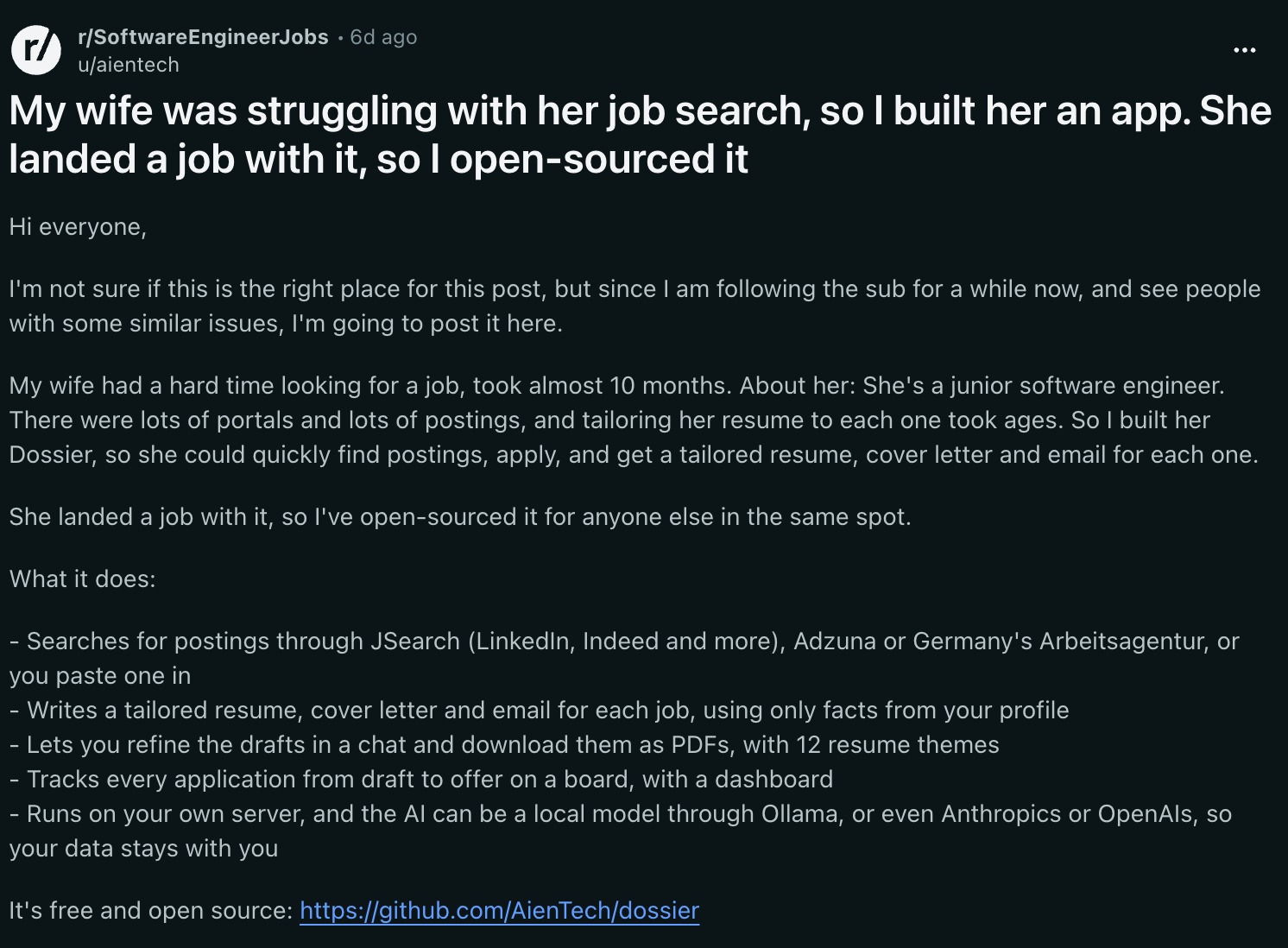 After his wife spent 10 months job hunting, a Reddit user built Dossier. It finds listings, writes a tailored résumé and cover letter for each, and tracks every application.
She got the job. He open-sourced it: github.com/AienTech/dossier
View post →
|
|
|
🧠 Knowledge Bank |
|
|
Neural Processing Units (NPUs)
| • |
An NPU is a dedicated chip optimized for running trained neural networks through inference—making predictions on AI tasks like object detection and speech recognition. Unlike CPUs or GPUs, it executes matrix multiply-accumulate operations at low precision, delivering AI performance under 5 watts. In video calls, an NPU handles background removal while CPU manages applications and GPU handles graphics. |
| • |
NPU-equipped laptops in India cost Rs 1,34,990 to Rs 2,76,991, making on-device AI accessible to millions. Builders save cloud API costs by processing locally. Tier-2 and Tier-3 users gain offline AI capabilities. The software gap remains—developers routing work to CoreML, DirectML, and ONNX Runtime will deliver superior latency, privacy, and offline experiences competitors cannot match. |
|
|
|
|
വീണ്ടും കാണാം
That's it from us today. Spotted something we should cover? Know a founder building something interesting? Reply — we're always listening.
Something big is always just around the corner. See you soon.
Were you forwarded this? Join free at mailr.tech
|
|
|
You're receiving this because you subscribed to Mailr.
© 2026 Mailr
|
|
|