Mailr — Wednesday, 4 November 2026
 |
| WED, 4 NOV, 2026 |
ISSUE # 93 |
|
|
Should you let AI agents in?
MakeMyTrip is building its own and betting on offline supply; IndiaMART is shutting them out, even at the cost of leads. DeepSeek’s new agent doesn’t wait to be asked, and TRAI’s draft says telcos must answer for the AI they buy |
| |
|
📋 In today's Mailr:
|
|
|
🌍 Global AI |
|
DeepSeek tests an agent that watches team chats |

|
Image source: Generated using Google Gemini |
| • |
DeepSeek's Super-Agent is an open-source coding agent that sits in developer group chats, spots problems, and suggests fixes without being prompted. Its stated goal: demand 'as little human attention as possible', shifting AI from a tool you query to one that acts on its own. |
| • |
Built by DeepSeek's new 'Harness' team and announced on WeChat, it is research software, not a commercial product. DeepSeek has raised roughly $15bn ahead of a planned IPO. The US has already banned its products from federal agencies over data concerns. |
|
Bottom Line: Coding agents are shifting from on-demand tools to always-on teammates with access to internal conversations. Before deploying any open-source agent in team channels, audit what data it can read and where it sends it. |
|
|
|
🇮🇳 India |
|
MakeMyTrip bets India's offline supply beats AI agents |

|
Image source: Generated using Google Gemini |
| • |
MakeMyTrip CEO Rajesh Magow argues ChatGPT-style assistants cannot replace travel platforms because most Indian hotels, homestays and bus operators are not usably listed on the open web. Two decades of transaction data and post-booking service are the real moat. |
| • |
Its own assistant Myra handles 90,000-plus conversations a day, up from 25,000 a year ago, supporting 3,000-plus bookings daily. Plain-language hotel searches convert 24% better than filter-based search, suggesting AI interfaces lift outcomes when built on proprietary supply. |
|
Bottom Line: Incumbent platforms are reframing their data and supply relationships as a moat against AI agents rather than a legacy cost. If you are building an AI travel or commerce layer for India, ask whether the supply you need is actually on the open web. |
|
|
|
IndiaMART walls off its data from AI agents |

|
Image source: Generated using Google Gemini |
| • |
IndiaMART has moved content behind logins and blocked AI scrapers, willingly sacrificing 10-20% of its 27 million unique business enquiries to protect proprietary data. CEO Dinesh Agarwal says Google AI Overviews now appear on over 50% of relevant searches, up from 10-20%. |
| • |
IndiaMART is open to licensing redacted data for AI training if paid, but will keep agent access restricted. It spends 8-10 crore rupees a quarter on performance ads to recover lost reach, while its own voice AI serves up to 100,000 buyers a day. |
|
Bottom Line: Platforms with proprietary B2B data are starting to treat AI crawlers as extractors, not distributors, accepting traffic losses to preserve data leverage. Startups building on top of scraped or syndicated Indian B2B data should expect that supply to shrink. |
|
|
|
TRAI draft makes telcos answer for vendor AI |
|
Image source: Generated using Google Gemini |
| • |
TRAI's draft guidelines hold telecom operators accountable for every AI system they use, whether built in-house or bought from a vendor. Operators must maintain a risk-rated inventory, run pre-launch tests for accuracy and fairness, and form a board-level AI safety committee with shutdown authority. |
| • |
Before buying AI, operators must vet the supplier and its training data, and write audit rights and incident management into contracts. Serious AI incidents must be reported to TRAI. The draft adds no new penalties; comments close 27 November. |
|
Bottom Line: Regulators are assigning liability to the deployer, not the developer, which restructures how AI is sold into regulated industries. Startups selling AI to Indian telcos should expect audit clauses, training-data disclosures and incident-reporting obligations written into every contract. |
|
|
|
⚡ Mailr Signal |
|
|
Three Indian platform stories in one week, all converging on the same question: when AI agents can query and act on your data, is distribution a gift or a liability? MakeMyTrip, IndiaMART, and now TRAI are each answering differently, and their answers will set the template for how Indian platforms negotiate with AI infrastructure for the next decade.
Our take, not a news summary.
|
|
|
🛠️ Tool of the Day |
|
|
Creedom
AI coach analyzes content and suggests posts for creators
| 🇮🇳 |
Creedom is headquartered in Bengaluru with a free plan offering 25 monthly credits, making it accessible for Indian creators. |
| ✅ |
Recognized as Official Meta Tech Partner and YouTube Official Partner on December 20, 2025, having raised 41 million INR in seed funding. |
| 💡 |
Best for: Indian content creators on Instagram and YouTube can analyze past content performance through an AI companion instead of conventional dashboards. |
View tool →
|
|
|
📱 Social Scan |
|
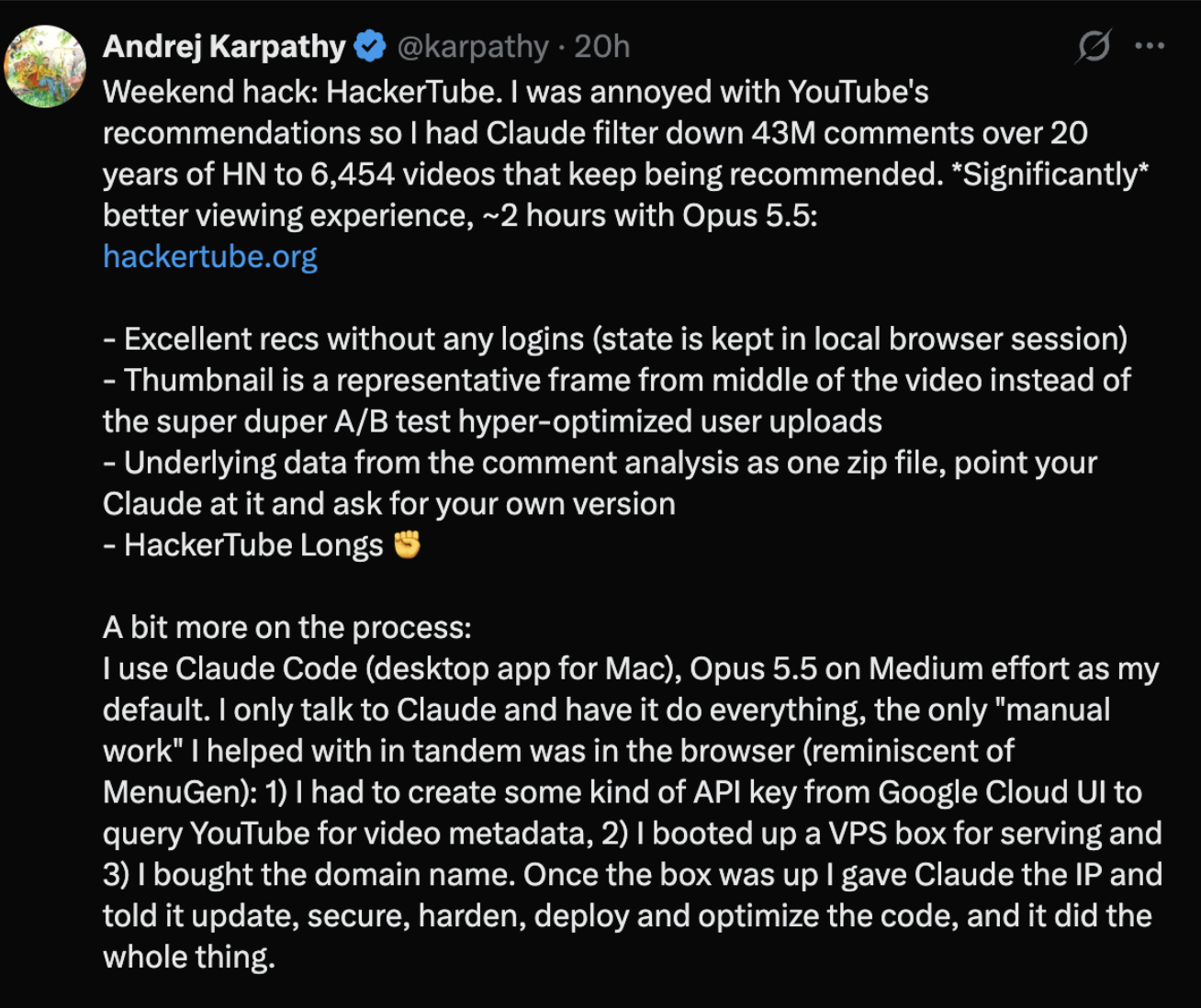 Fed up with YouTube's recommendations, AI researcher Andrej Karpathy, an OpenAI co-founder and Tesla's former AI chief, built his own.
He had Claude sift through 43 million comments from 20 years of Hacker News to find the 6,454 videos people keep recommending. The result is HackerTube: no login, no clickbait thumbnails, just videos people actually vouched for.
It took about two hours. Claude wrote, secured and deployed the code. His only jobs were creating an API key, renting a server and buying the domain.
Try it: hackertube.org
View post →
|
|
|
📖 Read of the Week |
|
|
Experts Unknowingly Defer to AI Agents' Random Choices
by Amaç Herdağdelen, Hailey Joren, Alex Tamkin
| • |
Anthropic's randomized trial revealed experts adopted AI agents' preferences on 86% of analytical decisions, even when those preferences were randomly assigned. Most analysts copied agent arguments verbatim yet only 15% acknowledged the agent shaped their judgment. |
| • |
Builders should stop treating human sign-offs as independent checks by default. Design agents that present both options or elicit expert views first. Organizationally redesign workflows to ensure genuinely independent human judgment on critical decisions. |
|
|
|
|
మళ్ళీ కలుద్దాం
That's your Mailr for today. Spotted something we missed? Hit reply — we read every one.
Big things are being built. See you next edition.
Were you forwarded this? Join free at mailr.tech
|
|
|
You're receiving this because you subscribed to Mailr.
© 2026 Mailr
|
|
|